


1. Why flux orientation matters? Why talk about it at all?
When you need to choose an electric motor for a project, you usually start from questions like:
How much torque and power do I need?
How much space do I have available?
How important are weight, efficiency, and cost in my application?
But behind these questions sits another fundamental design choice: which motor geometry allows you to achieve these metrics? The motor’s geometry greatly determines what you can achieve in terms of torque, power density, packaging size, mass, efficiency, cooling and cost.
In this article, the focus is to explain what flux orientation (radial or axial) actually means for you as someone selecting a motor. Once understanding this will help you make a more informed choice between both solutions.
2. Basic idea of radial and axial magnetic flux orientations
Every motor has three basic elements:
The stator: the stationary part, usually carrying the windings.
The rotor: the rotating part, attached to the shaft.
The rotational axis: the axis around which the rotor turns.
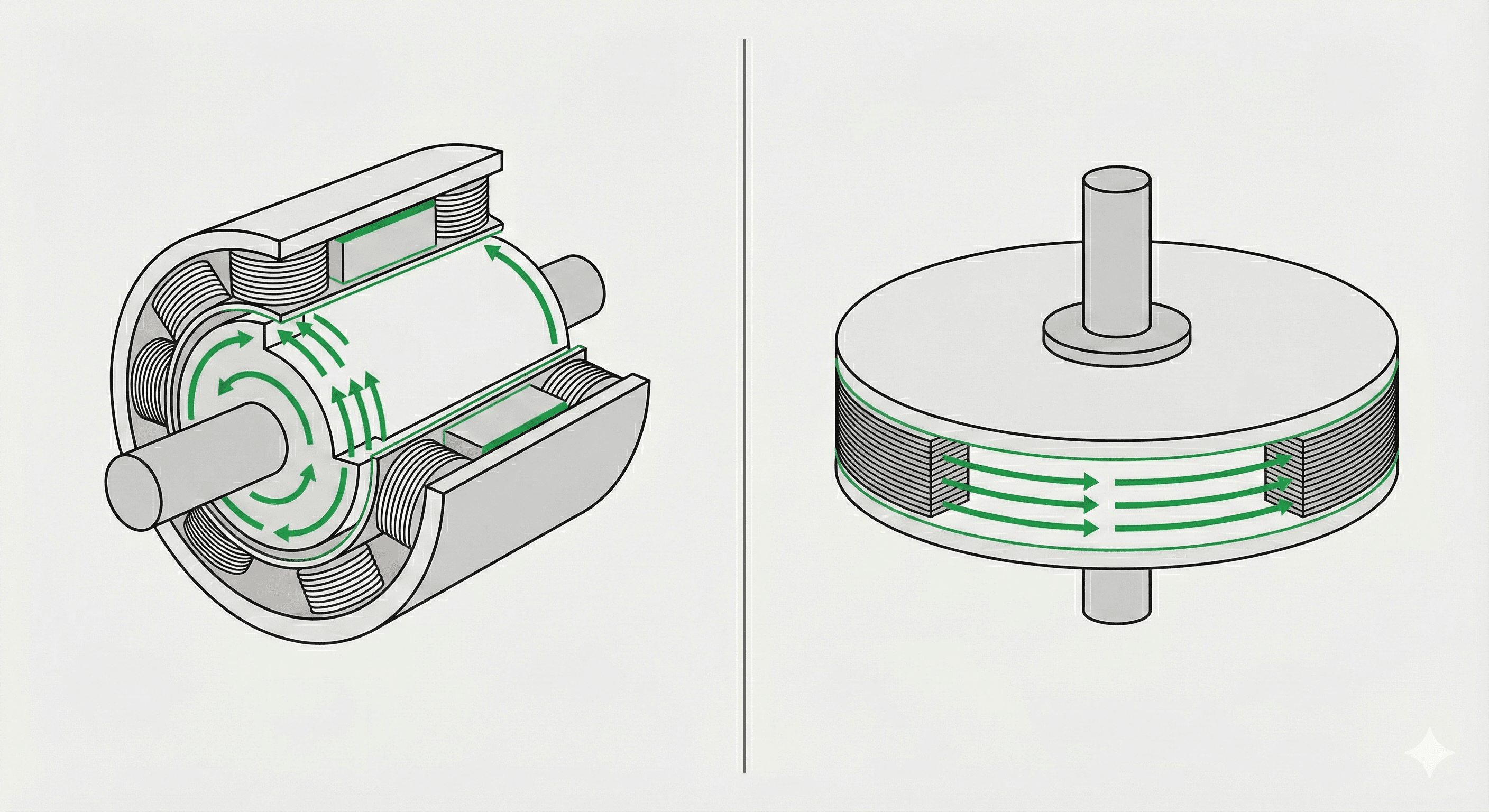
The way that the magnetic flux crosses the air gap between the stator and rotor defines the motor geometry:
Radial flux machines
The magnetic flux crosses the air gap radially, like spokes pointing from the centre outwards.
The motor looks cylindrical, with a rotor inside (or outside) a stator. This is why radial flux motors are normally longer but smaller in diameter.
Axial flux machines
The magnetic flux crosses the air gap axially, parallel to the shaft.
The motor looks more like a disc or “pancake”, with rotor and stator facing each other as flat plates. This is why an axial flux motor might be shorter but larger in diameter, with possibly much higher torque density.
Because the torque is generated at a larger mean radius and the flux path can be very short, axial flux motors can reach significantly higher torque per volume and per mass than comparable radial designs.
The flux orientation (radial or axial) is independent of other choices such as magnet type and control method. This means that you can control an axial flux motor the same way you can control a radial flux motor.
Note: another possible geometry is the transverse-flux motor, which we omit here because it is rarely used in common applications.
In the rest of the article, we will look deeper at these geometries, and explain their strengths and limitations, so that you can narrow down the right motor for your project.
3. Radial flux machines
Strengths of radial flux motors
Mature technology, with a larger supplier base and many off-the-shelf options in standard dimensions.
Normally easily manufacturable.
Efficient for a wide range of powers and speeds.
Limitations and trade-offs
Packaging: For a fixed outer diameter, the torque of a radial flux motor scales roughly with the motor’s length, so the usual way to get more torque is to make the motor longer. This can create integration issues if you have limited axial space.
Torque and power density limited by outer diameter and cooling surface: If diameter must stay small, and you already use a long motor, you eventually hit a limit in torque/power density.
In many projects these limitations are not critical, but for very compact, light-weight, or high-torque systems, they can make radial flux less attractive than axial flux.
Typical applications
Because of their maturity and flexibility, radial flux motors are used in a very wide range of applications, like:
Industrial drives: Pumps, fans, compressors, conveyors, mixers, machine tools.
EV traction
General-purpose motors (IEC / NEMA frame):
4. Axial flux machines
Strengths of axial flux motors
Very high torque density: For applications where every kilogram and every millimetre counts.
Excellent use of axial space leads to a smaller package: The motor fits well where length is limited.
Limitations and trade-offs
Cooling design is critical: Without an optimized geometry and cooling, you may not fully exploit its power density. Advanced tools, such as WheemX™, offer the necessary design approach to effectively overcome these challenges.
Manufacturing: Not all manufacturers are equally experienced in axial flux production, and supplier choice becomes more important.
Sensitivity to air-gap uniformity and mechanical alignment: Because the discs face each other, maintaining a uniform air gap over the full diameter is crucial. A good axial flux design must handle these aspects from the start.
These challenges highlight the reason you should work with a supplier that has specific expertise in axial flux design, simulation, and manufacturing to fully benefit from its geometry.
Typical applications
Thanks to their torque density and packaging advantages, axial flux motors are particularly attractive in applications such as:
Electric vehicles where packaging is critical: In-wheel drives, e-axles and compact drive units and high-performance or premium vehicles aiming for higher power density.
Aerospace and eVTOL: Very strict weight and volume constraints.
Robotics and special-purpose drives: Compact actuators where short length and integrated mechanics are valuable, direct-drive joints and rotary tables.
Marine applications (direct-drive propulsion): Low-speed, high-torque drives where gearboxes can be reduced or eliminated. Space and noise constraints favour high-torque, compact solutions.
Off-highway and industrial applications: Machinery where short drive units simplify integration.
5. Comparing radial and axial flux machines
Comparison table for the most important metrics
The table below gives a simplified overview of how both technologies typically perform against a set of practical criteria.
Characteristic | Radial flux motor | Axial flux motor |
Torque Density | o | ++ |
Power density | o | - |
Efficiency | + | + |
Cooling | + | o |
Axial height (length) | - | ++ |
Radial height (diameter) | ++ | - |
Mass | o | + |
Mechanical integration | o | + |
Manufacturability | ++ | - |
Cost | + | o |
Legend:
-- very unfavourable - unfavourable o neutral / typical + good ++ very good
How is torque created in both geometries, and how does it scale with size?
At a very high level, both radial and axial flux motors create torque in the same way. If we assume similar materials and loading, the main difference between topologies is how much active area you have in the air gap and at which average radius this area sits.
Radial flux motors: torque ∝ diameter² × length
For a fixed diameter, torque grows linearly with active length.
For a fixed length, torque grows roughly with the square of the diameter.
The diameter is mainly set by your application constraints, so if you need more torque with the same diameter, the standard approach is to use a longer motor (more stack length) or a higher pole count, or both.
This is why radial flux motors tend to be longer compared to axial flux machines designed for similar torque.
Axial flux motors: torque ∝ diameter³
Torque scales roughly with the cube of the outer diameter for a given axial thickness.
This is why, for similar materials and loading, an axial flux motor can deliver more torque for the same weight and axial length than a radial motor.
In practice, actual torque is also limited by materials, cooling, and mechanical strength, but these geometric scaling laws explain why axial flux topologies are often chosen for high-torque, space-constrained applications.
6. How to choose the optimal topology for your application?
Simple rules of thumb for choosing a topology
When you are selecting a motor, you normally start from constraints as space, torque, speed, weight, and cost. The points below give simple rules of thumb to narrow down whether a radial or an axial flux motor is more likely to fit your application.
A radial flux motor is typically the natural choice, when:
Cost, robustness, and availability are key.
You have limited diameter but can accept length.
If you need to use existing standards.
An axial flux motor is normally the best choice when:
Packaging length is limited, but diameter is available.
High torque per mass or per volume is a priority.
You plan an integrated or unconventional layout (in-wheel, inside a drum, around a shaft flange).
You need extreme torque at very low speed with minimal or no gearbox.
These rules do not replace detailed calculations, but they help you quickly decide where to focus your discussions with motor suppliers.
When axial flux is particularly attractive
Axial flux is not just a “nice alternative” to radial flux; in some cases it is the geometry that truly unlocks the full potential of the system. Typical situations include:
You have a strict limit on axial length.
Your application is very weight-sensitive (vehicle dynamics, aerospace, mobile machines).
You require a high-torque density motor.
You want to integrate multiple functions on the same axis – motor plus brake, motor inside a wheel, motor directly driving a propeller or drum.
You have a high-end application that requires high toque at a compact packaging.
The system architecture already suggests a disc-like geometry (e.g. a rotating plate, flange, or wheel), where an axial flux motor can be packaged “around” or “into” existing components.
You are pushing for a step change in power density compared to standard solutions and are willing to optimise the cooling and mechanical design accordingly.
Working with a partner that can simulate and tailor axial flux designs to your application can turn these geometric advantages into real gains in torque, efficiency, and packaging for your project. If you want to explore whether this is the case for your application, contact us. We can help you evaluate whether an axial flux topology is the right fit and what kind of performance you could realistically expect.
7. Conclusion
Motor geometry is a key decision in motor design. Understanding the difference between radial and axial flux machines helps you make better choices when you select a motor for your project.
Radial flux machines are typically longer and slimmer, with a wide supplier base, and good performance for many industrial and automotive applications. Axial flux machines, in contrast, use a disc-shaped layout to generate torque at a larger radius, enabling very high torque density in a compact packaging.
To move from general guidelines to concrete numbers, detailed simulations and optimisation are needed. Tools like WheemX allow us to model geometry, materials, cooling and control to quantify trade-offs between radial and axial designs and to see what is realistically achievable in your operating conditions.
If you are planning a new system or evaluating alternatives to an existing motor, share your key requirements with us, and we can help you assess whether an axial flux solution is the best match for your application.